

One of the most persistent hurdles in addressing eating disorders within the Arab and Muslim world is the lack of standardized, region-wide statistics. While we cannot give the exact, definitive numbers of sufferers in our communities due to a lack of formal data collection, the frontline reality is undeniable: cases are rising rapidly, and they are targeting the core of our society.Historically, eating disorders were frequently dismissed as a distant, external crisis—something confined to Hollywood screens or Western media. Maha recalled how the illness once felt like a far-away fantasy to her. Today, that fantasy has been brought directly into the pockets of our youth.
The Road to Recovery: Why We Are Addressing the
Hardest Part of
Eating Disorders First
Dear Visitors,
Please find below a detailed breakdown of our landmark webinar, “The Road to Recovery’, along with its key findings. This session took place on October 16, 2026, bringing together an extraordinary panel of clinical experts and lived-experience advocate.
We are bringing this comprehensive summary directly to you so you can easily catch up the profound insights, data shifts, and cultural breakthrough discovered during the event.
the conversation surrounding eating disorders in our society is changing rapidly. We hope you will deeply reflect on and enjoy the vital lessons shared by our speakers as we look at healing through a holistic lens of community, family, and spiritual resilience.
When looking at the global crisis of eating disorders, the conversation often centers heavily on the triggers, the symptoms, or the physical diagnosis. Yet, ask anyone who has stood on the frontlines of this battle, and they will tell you the exact same thing: the single most difficult, grueling, and complex phase of an eating disorder is going through the daily reality of sobriety and recovery.
This is a massive, quiet issue worldwide, and it is precisely why the Arab Eating Disorders Association (AEDA) chose to tackle it head-on. For our inaugural, milestone Zoom session, we didn’t want to look only at how these disorders begin. We chose to address “The Road to Recovery” first, recognizing it as the most pivotal and challenging milestone on the journey to healing.
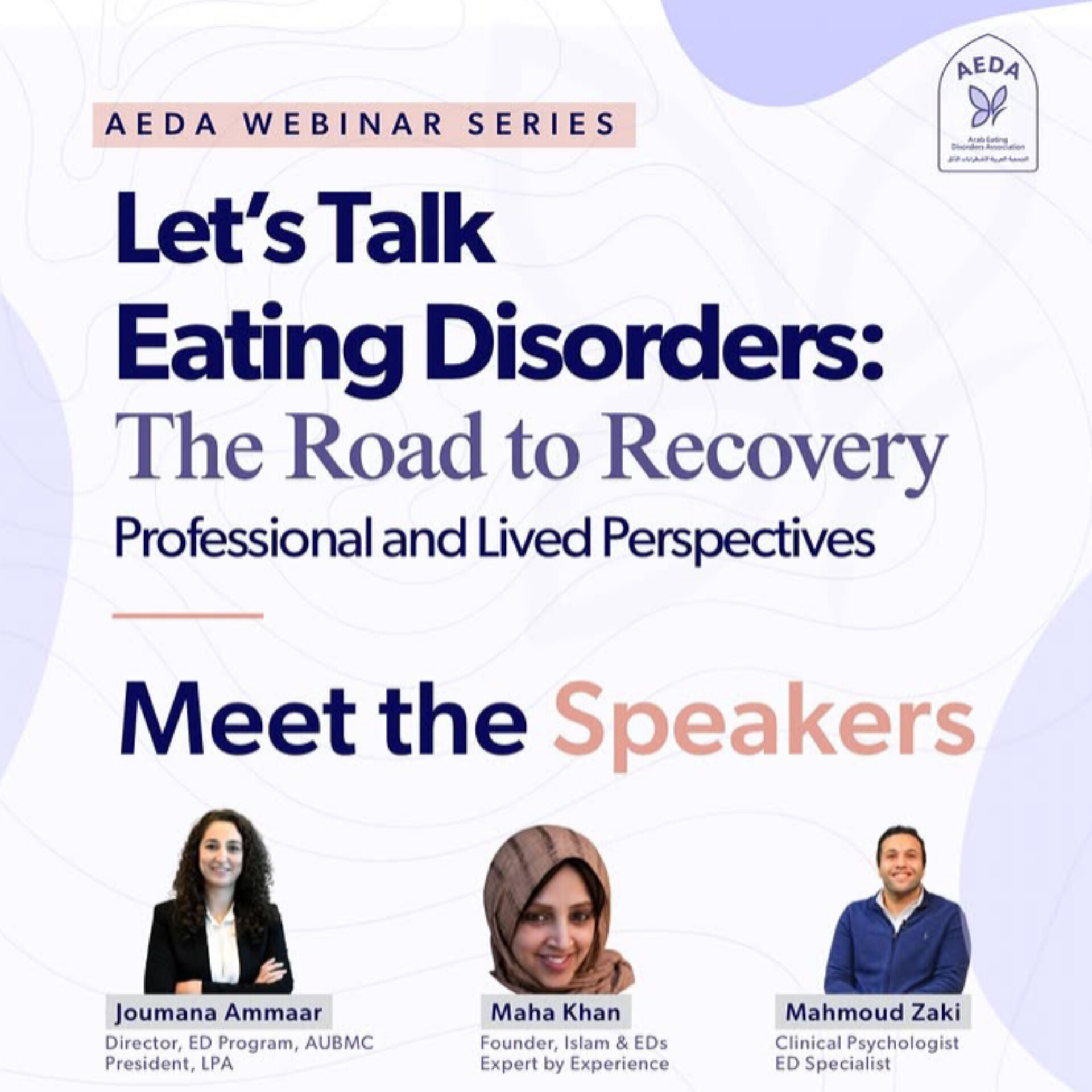
To navigate this vital topic, this special session brought together an extraordinary group of professionals and a lived-experience advocate, beautifully hosted and guided by Hala, who facilitated this deep, eye-opening dialogue. Hala brought these distinct voices together to bridge the gap between clinical expertise and the raw, human reality of the illness:
• Dr. Mahmoud Zaki (Egypt): Bringing crucial clinical insights from North Africa on changing family dynamics, societal pressures, and the rise in help-seeking behaviors.
• Joumana (Lebanon): A seasoned clinician offering stark, frontline realities regarding the rapidly dropping age of onset and the digital threats modern patients face.
• Maha (Lived-Experience Advocate): The vital bridge of the panel, sharing her personal, raw journey through treatment resistance, relapse, and ultimate spiritual reclamation.
The Unspoken Rise in the Arab and Muslim World
One of the most persistent hurdles in addressing eating disorders within the Arab and Muslim world is the lack of standardized, region-wide statistics. While we cannot give the exact, definitive numbers of sufferers in our communities due to a lack of formal data collection, the frontline reality is undeniable: cases are rising rapidly, and they are targeting the core of our society.
Historically, eating disorders were frequently dismissed as a distant, external crisis—something confined to Hollywood screens or Western media. Maha recalled how the illness once felt like a far-away fantasy to her. Today, that fantasy has been brought directly into the pockets of our youth.
With 24/7 digital access, algorithmic media, and artificial intelligence, the vulnerability is immediate. Joumana shared a startling revelation from her clinic in Lebanon: two 10-year-old children were recently hospitalized with severe anorexia, both having used ChatGPT to source instructions on how to lose weight. Dr. Mahmoud Zaki confirmed this shift in Egypt, noting that the internet is taking precedence over traditional family and religious structures, acting as an unregulated gateway to self-harm for 11- and 12-year-olds.
The Illusion of Force vs. The Power of Readiness
Because the journey to recovery is so intensely difficult, well-intentioned families and clinicians often default to control. Maha shared that early in her journey, she was pushed into Enhanced Cognitive Behavioural Therapy (CBT-E) and inpatient family therapy entirely against her will.
The panel highlighted a critical lesson from her experience: forced clinical treatment often creates deep, active resistance. When treatment is pushed upon a patient before they are mentally ready, they will use their own intellect and knowledge as a shield to work against the clinical system. Standard guidelines hold very little weight if the internal willingness is absent.
Instead, Maha’s true turning point arrived after a painful relapse. Hitting rock bottom made her realize how incredibly limited, restricted, and confined her life had become. The decision to step into sobriety had to be autonomous. Crucially, the panel noted that early, seemingly “failed” treatment is never truly wasted; the clinical knowledge Maha stored during those difficult early days became the exact toolkit she accessed once she made the conscious, personal choice to heal.
Healing the Micro-Environment: The Danger of Careless Words
Hala guided the speakers into a deeper look at the home, revealing that one of the highest risks for relapse comes from within the immediate family environment. Eating disorders are incredibly complex, interwoven with societal expectations and micro-level family dynamics.
Joumana emphasized the absolute necessity of counseling both parents. Everyday triggers often stem from words uttered without care. For instance, a mother pausing a family photo to say, “Stop, don’t take it yet until I suck in my belly,” can inadvertently send waves of body anxiety through a vulnerable child.
True recovery demands proper nutrition; no one can heal without honoring the physical food journey. When the surrounding household remains hyper-focused on weight and aesthetics, the path to sobriety is blocked. To successfully treat the individual, we must actively educate, counsel, and psychoeducate the parents.
Recovery is Not a Catchy Phrase
Dr. Mahmoud Zaki offered a profound truth regarding the reality of healing: recovery is not a linear process, and it is certainly not just a catchy phrase. It is a complex, unpredictable reality filled with twists and turns.
There will be setbacks, and there may be continuous relapses—and that is entirely okay.
Dr. Zaki warned that the recovery process must never be used as a tool for control or manipulation by either the patient or the family. True healing cannot exist under rigid surveillance. It requires deep flexibility, leniency, and patience from everyone involved. We cannot freeze a person’s progress based on a single bad day.
The Ultimate Spiritual Anchor
While clinical frameworks provide the necessary structure for recovery, the human spirit provides the fuel. The webinar beautifully illustrated how reframing a medical struggle through a lens of purpose and faith can completely alter the trajectory of healing.
For Maha, recovery became possible when she received deep, human validation—being told that “the human spirit is strong enough to crush mountains.” Furthermore, she found immense strength by anchoring her journey in a verse from Surah Ali ‘Imran, reframing her agonizing recovery as her personal Jihad—a meaningful, divinely assigned struggle meant to help her rise above, protect her body, and succeed.
Dr. Zaki beautifully harmonized with this, reminding us that everyone on this earth has been given a unique purpose and a specific work to do. Recovery is ultimately about reclaiming your health so you can step forward and fulfill that divine purpose.
Conclusion: Moving Forward Together
This milestone webinar provided a profound look into the heart of our communities, our culture, and our society. We learned deeply about the immense complexity of eating disorders in the modern world. Simply recognizing the issue is no longer enough—we must acknowledge that cases are rising rapidly and confront the reality head-on.
Moving forward, the answer lies in creating aggressive awareness on all levels of society and implementing widespread psychoeducation. By replacing rigid control with empathy, recognizing the impact of the digital age, and anchoring treatment in both clinical tools and spiritual resilience, we can protect our future generation and help them reclaim their divine purpose. 


