

Dear Readers,
Please find below a very helpful post by Natasha to help people navigate Ramadan with their Eating Disorder. Since 2020, Ramadan has been different to what we are used to. For anyone struggling with Eating Disorder, Ramadan is often a time when the spiritual cheer is replaced with a heightened sense of fear. And although the opportunities to socialise may look a little different this Ramadan, it doesn’t mean that feelings of anxiety and worry will ease. Ramadan is still likely to be an exceptionally challenging time for many of the Muslims in recovery from an Eating disorder, especially if you are just beginning or early on in your recovery journey.
Navigating these situations—where everyone around you seems to be on spiritual high while you feel like you’re struggling just to hold it together—can be overwhelming, isolating, and emotionally taxing. If you’re in that position right now, know that it’s okay to be having a hard time and that this year in particular professionals from the eating Disorder field and other Mental Health fields have come up with some guidance and encouragement that might help make getting through it just a little bit easier.
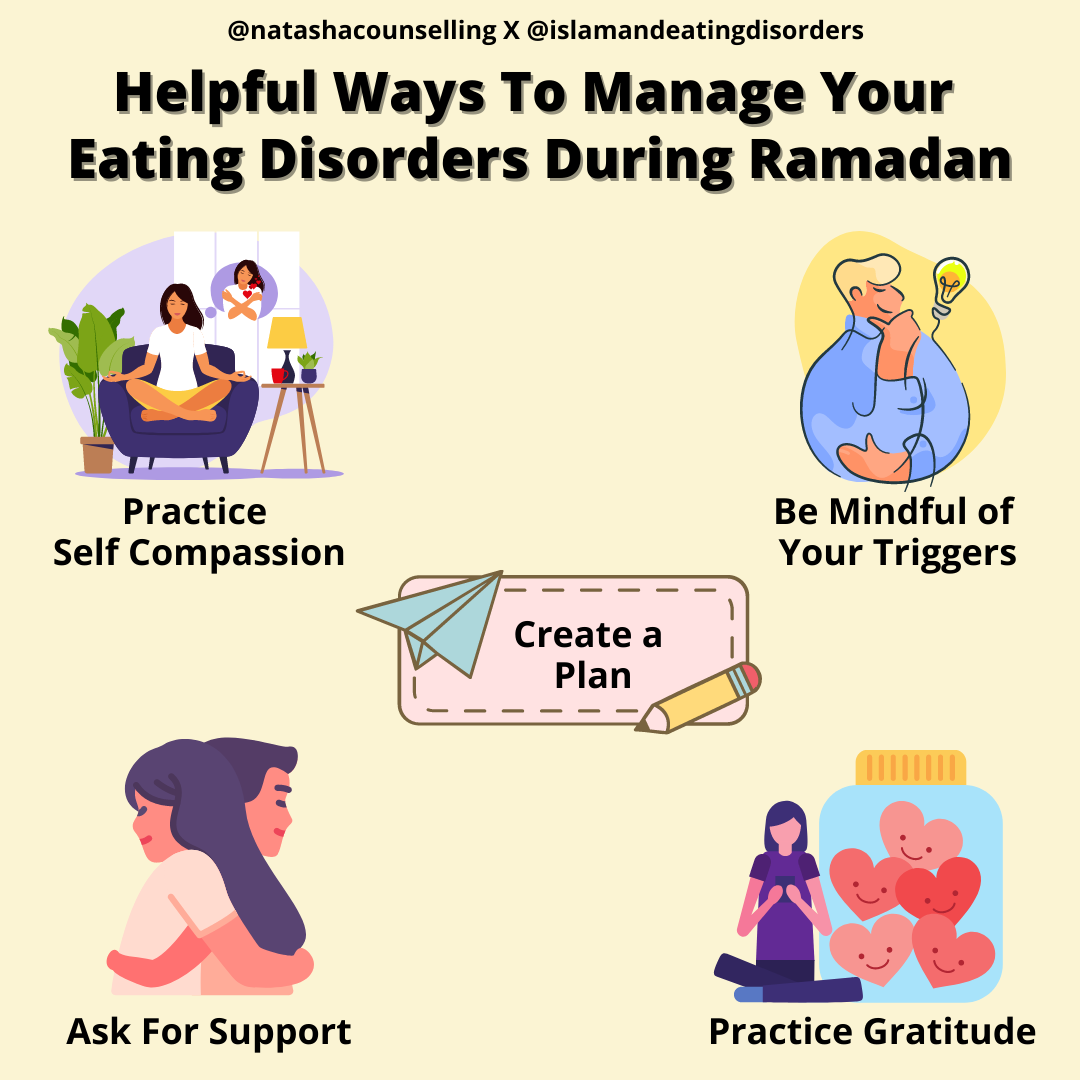
Natasha Ramzan has come up with Helpful Ways to Manage your Eating disorders this Ramadan.

In today’s post, We will be focusing on managing disordered eating behaviours during Ramadan. The ‘Ramadan diet culture’ is relatively normalized and can cause further damage. People struggling with an eating disorder may find it challenging to manage their illness during the month of Ramadan.
It can be difficult to differentiate whether you are fasting for spiritual purposes or fasting for your eating disorder.
One study shows that Ramadan fasting was not correlated with disordered eating behaviours and participants’ motivation to fast was due to spiritual decisions rather than weight control (Duzeker et al., 2019). However, medical professionals, be they Muslim or not, will recommend against fasting at any point in your recovery and even after you have recovered, as it is simply too much of a risk. Recovery is dependent on maintaining a meal plan and regular nourishment, which is why missing even one meal can have a substantial negative impact. Your recovery and wellbeing will always come first, and if you delve deeper into the Quran, you will find further proof of this.
Here are six different ways to observe Ramadan while managing your disordered eating behaviours, and they are equally as valid as fasting.
1) It is essential to remind yourself that you are not any less Muslim if you cannot fast due to your mental illness. Be more mindful of how you talk to yourself and others. This month is also about reflecting on our behaviours and making an effort to change them if necessary.
2) The word Alhamdulillah signifies gratitude in our everyday lives. Gratitude in Islam is a form of worship.
3) You may also feel anxious about eating in front of many people, being around food, and hearing about food; if possible, share your concerns with someone you trust. Speaking to family members beforehand may reduce accidental unhelpful comments.
4) You may find it helpful to create a plan with your therapist to manage your eating disorder during Ramadan and follow it. As Ramadan progresses, you can keep adapting your plan until you feel more confident.
5) Being around food and constantly hearing about food can be quite triggering. If you are someone who binges or purges (now or in the past), you will know that these behaviours are often triggered by hunger and long periods of low food intake. If you decide to fast, please do not miss Suhur or Iftar, which will increase the risk of losing control the next time you eat.
Disclaimer:
This post is for psychoeducation only. Please consult with your doctor or mental health professional if you are struggling with your disordered eating during Ramadan.Credit: Maudsley Health, Abu Dhabi; Duzeker et al., 2019

Psychotherapist and Clinical Social Worker
Together we will develop a confidential relationship in which you can feel safe, heard and understood, where you can share your concerns and challenges, see them more clearly and develop better ways of coping with them.
A bit about myself, I moved to Canada when I was ten years old. I am the eldest of four siblings. I have struggled with balancing dual cultural values (Canadian and Pakistani), which sometimes resulted in conflicts with my parents and led to experiencing anxiety and perfectionism. However, I have learned to balance and embrace both cultures’ values with time and have been managing my struggles with anxiety. I have always been passionate about spreading mental health awareness, especially within ethnic minority communities. I completed my bachelor’s in psychology from York University and then pursued my master’s degree in clinical social work at the University of Toronto, specialized in mental health and health. Currently, I am completing my doctorate in Clinical Psychology at King’s College London University. When I am not working, I love spending time with family and friends. I enjoy blogging about mental health, reading a good book, hiking especially during the fall season and binge-watching Netflix. I also love travelling, which is my self-care.
I believe in a holistic and an anti-oppressive approach, considering biopsychosocial factors rather than just focusing on mental health disorder symptoms.
Specialties:
Borderline personality
Anxiety-related disorders including OCD
Eating disorders
Relationship/marital issues
Depression
Work or school related stress
Life adjustment issues
Transitioning difficulties for new immigrants
Treatments Offered:
Dialectical Behavior Therapy
Cognitive Behavioral Therapy
Family-Based Treatment for Eating Disorders
Mindfulness-Based Cognitive Therapy
Emotion-Focused Therapy
Solution Focused Therapy
Systemic Family Therapy
Qualification, Training and Membership:
BA (Hons) in Psychology
Master’s in Clinical Social Work
Doctorate in Clinical Psychology (in progress)
Member of The British Psychological Society
Member of the Ontario College of Social Workers and Social Service Workers
Member of the Ontario Association of Social Workers
www.natashacounselling.com
Instagram: NatashaCounselling

